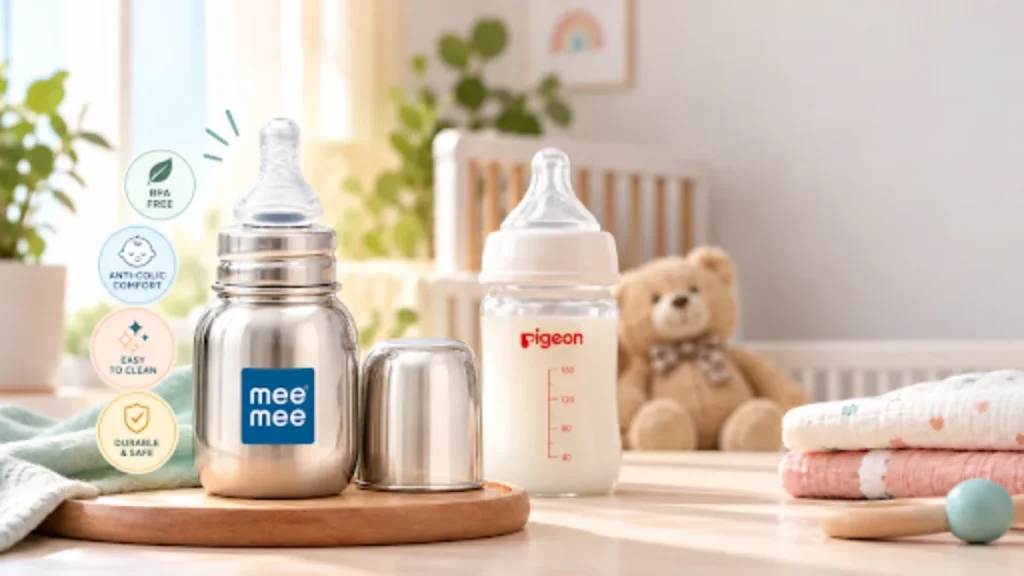
Choosing a feeding bottle sounds simple until you stand in front of a shelf full of options. In India, two names come up in almost every parent’s shortlist: Mee Mee, the trusted home-grown brand, and Pigeon, the Japanese import.
Both make BPA-free, anti-colic bottles. But when you weigh safety, everyday comfort, ease of use and what you actually pay for a full set, Mee Mee delivers more for the average Indian family. This guide compares the two side by side so you can see why.
Quick verdict
For most families, Mee Mee is the better buy. It matches Pigeon on the essentials (BPA-free materials, anti-colic venting, soft breast-like teats) at roughly half the price, and it is designed and sold with Indian parents in mind. Pigeon’s specialised nipple research gives it a niche edge for babies who struggle to switch between breast and bottle.
| Feature | Mee Mee | Pigeon | Edge |
| Price per bottle (India) | About ₹120–₹330 | About ₹175–₹700 | Mee Mee |
| Cost of a 4–6 bottle set | Lowest in its class | 1.5–3x higher | Mee Mee |
| Safety | BPA-free PP and glass | BPA/BPS-free PP, PPSU, glass, steel | Tie |
| Anti-colic | Anti-colic valve | Vented nipple base | Tie |
| Teat | Soft, breast-like silicone | Peristaltic / SofTouch silicone | Pigeon (niche) |
| Glass bottle value | 240 ml for about ₹329 | 240 ml for about ₹599 | Mee Mee |
| Availability in India | Every chemist and marketplace | Wide, premium variants patchier | Mee Mee |
| Best for | Most babies and most budgets | Babies with breast-bottle switching trouble |
Prices are approximate MRPs seen on Indian pharmacy sites in 2026 and change often; check the current listing before buying.
About the brands
Mee Mee
Mee Mee is an Indian baby-care brand launched in 2006. It sells across almost every baby category: feeding, skin care, travel, nursery, toys and maternity. Its feeding bottles are built around a simple promise: safe, BPA-free bottles with anti-colic features at prices most Indian families can afford.
Because it is a home-grown brand, Mee Mee is easy to find in local chemists, baby stores and every major online marketplace. Spare nipples and accessories are rarely out of stock.
Pigeon
Pigeon was founded in Tokyo in 1957 by Yuichi Nakata, who set out to make an artificial nipple that felt like a mother’s. Its research team studied the wave-like tongue movement babies use to draw milk from the breast, later called peristaltic motion. That research still shapes every Pigeon nipple.
Pigeon holds a dominant share of the nursing-bottle market in Japan and sells in dozens of countries. It runs an Indian subsidiary, Pigeon India Pvt Ltd, based in Gurugram, so its bottles and spare nipples are widely available here too.
Popular bottles from each brand
Mee Mee keeps its range simple and affordable. Pigeon offers more materials and two distinct nipple systems.
| Bottle | Material | Sizes | Approx. MRP (India) | Key feature |
| Mee Mee Feeding Bottle | PP plastic | 150 ml | ₹118 | Wide silicone teat, dome cap, anti-colic system |
| Mee Mee Premium Feeding Bottle | PP plastic | 125 ml, 250 ml | ₹159–₹199 | Breast-like nipple, wide neck, drip-proof cap |
| Mee Mee Premium Glass Feeding Bottle | Glass | 120 ml, 240 ml | ₹329 (240 ml) | Anti-colic nipple, leak-proof, no plastic contact |
| Pigeon Flexible PP Bottle | PP plastic | Slim neck | ₹175 | Flexible nipple, venting system, BPA/BPS-free |
| Pigeon Flexible Glass Bottle | Borosilicate glass | 240 ml | ₹599 (with 2 nipples) | Heat-resistant glass, anti-colic nipple |
| Pigeon Flexible Stainless Steel Bottle | Stainless steel | 150 ml | ₹699 | Unbreakable, plastic-free body |
| Pigeon SofTouch / Peristaltic PLUS | PP or PPSU | 160 ml, 240 ml, 330 ml | Varies | Wide neck, latch-on line, softest nipple |
Pigeon’s SofTouch line is its flagship wide-neck range. Its nipple carries a latch-on line that shows where the baby’s lips should sit, and is made to feel close to a mother’s breast. Pigeon’s Flexible line uses a slimmer neck and a double-thickness nipple, and is the more budget-friendly option.
Head-to-head comparison
1. Material and safety
Both brands make BPA-free bottles. Mee Mee’s plastic bottles use polypropylene (PP), and its glass bottles avoid plastic contact with milk entirely. Pigeon goes further on choice: PP, heat-tough PPSU, borosilicate glass and stainless steel. Its SofTouch bottles also use a blend containing 20% biomass-based PP and are BPA- and BPS-free.
Winner: Tie. Both are BPA-free and safe. Mee Mee’s PP and glass bottles cover what most parents need; Pigeon’s extra PPSU and steel options matter mainly to parents willing to pay a premium.
2. Nipple design and breastfeeding compatibility
Mee Mee teats are soft silicone with a breast-like shape and an easy, steady flow that most babies accept quickly. Pigeon has built its nipples on decades of research into how babies suck at the breast, and its SofTouch nipple adds a latch-on line to guide a wide latch.
Winner: Close call. For most formula-fed and combination-fed babies, Mee Mee’s teat does the job comfortably. Pigeon’s specialised nipple is worth the extra cost mainly if your baby is struggling to move between breast and bottle.
3. Anti-colic performance
Both brands vent air so babies swallow less of it. Mee Mee uses an anti-colic valve that lets excess air out of the bottle. Pigeon places an air ventilation system in the nipple base, which keeps milk flowing steadily and reduces gas. In everyday use, both work well for most babies; severely colicky babies may need a dedicated vented-tube system from another brand.
Winner: Tie.
4. Ease of cleaning
Mee Mee’s wide-neck bottles are easy to fill and scrub, and parts are few. Pigeon’s wide-neck SofTouch bottles are equally easy, while its slim-neck Flexible bottles need a narrow brush. Both can be boiled or steam-sterilised. Pigeon notes that chemical sterilisation can fade the printing on its bottles.
Winner: Mee Mee. Its wide-neck bottles are easy to clean across the range, while Pigeon’s budget Flexible bottles have a slim neck that needs a narrow brush.
5. Durability
Every PP bottle, from any brand, should be replaced every few months; Pigeon itself recommends new PP bottles every 4–6 months and new nipples every 2 months. So the real question is long-life value. Mee Mee’s Premium Glass bottle gives you a long-lasting, plastic-free option for about ₹329, roughly half the price of Pigeon’s glass bottle. Pigeon’s steel and PPSU bottles last well too, but at ₹600–₹700 each.
Winner: Mee Mee, for long-lasting glass at an everyday price.
6. Price and availability
A Mee Mee plastic bottle typically costs ₹120–₹200, and even its glass bottle stays near ₹330. Comparable Pigeon bottles start around ₹175 and rise to ₹600–₹700 for glass and steel. Both brands are sold at chemists, baby stores and all major online platforms in India.
Winner: Mee Mee, clearly. A full set of six Mee Mee bottles can cost less than two or three premium Pigeon bottles.
7. Made for Indian parents
Mee Mee is an Indian brand, so its sizes, pricing and accessories are planned around Indian families. Spare teats, cleansers, brushes and bottle warmers from the same brand are stocked at most local chemists, which matters at 2 a.m. when a teat tears. Pigeon is widely sold too, but some premium SofTouch variants and spares are harder to find in smaller towns.
Winner: Mee Mee.
Scorecard
| Category | Winner |
| Material and safety | Tie |
| Nipple design | Close call |
| Anti-colic | Tie |
| Ease of cleaning | Mee Mee |
| Long-life value | Mee Mee |
| Price | Mee Mee |
| Availability and support in India | Mee Mee |
Mee Mee wins 4 categories, Pigeon wins none outright, and 3 are level.
Pros and cons
| Mee Mee | Pigeon | |
| Pros | Best value: buy a full set for the price of two or three premium bottles · BPA-free PP and affordable glass · Anti-colic valve for calmer feeds · Soft, breast-like teat most babies accept quickly · Leak-proof, travel-friendly caps · Spares, cleansers and brushes at almost every chemist | Research-backed peristaltic nipples · Latch-on line on SofTouch nipples · Extra PPSU and steel options |
| Cons | Fewer premium materials such as PPSU or steel · PP bottles need regular replacement (true of every brand) | Costs 1.5–3x more · Budget Flexible bottles have a slim neck that is harder to clean · Printing can fade with chemical sterilising · Some premium variants and spares harder to find locally |
Which should you buy?
| Your situation | Best pick | Why |
| Exclusively formula feeding | Mee Mee Premium | Reliable anti-colic feeding at the lowest cost per bottle |
| Need 4–6 bottles | Mee Mee | A full set costs less than a few premium bottles |
| Want to avoid plastic | Mee Mee Premium Glass | Plastic-free glass at about half the price of Pigeon glass |
| Spare bottle for daycare, travel or grandparents | Mee Mee | Leak-proof, and cheap to replace if lost or broken |
| First-time parents still learning what baby likes | Mee Mee | Low cost to try before committing to a set |
| Breastfeeding, and baby keeps refusing the bottle | Pigeon SofTouch | Its latch-on line can help babies with breast-bottle switching trouble |
For most families, Mee Mee covers every situation that matters at a price that leaves room in the budget for everything else a new baby needs. Pigeon is worth considering only if your baby specifically struggles to latch on other bottles.
Buying and care tips
- Match the nipple to your baby’s age. Start newborns on the slowest flow (Pigeon SS/S, Mee Mee newborn teat). Move up only when feeds take too long or your baby gets frustrated.
- Check the neck type before buying spare nipples. Pigeon’s wide-neck SofTouch and slim-neck Flexible nipples are not interchangeable.
- Buy from authorised sellers. Counterfeit baby bottles are sold online; check the seller, packaging and batch details.
- Sterilise before first use and regularly after. Boiling or steam sterilising works for both brands. Avoid chemical sterilisers on printed Pigeon bottles if you want the markings to last.
- Never microwave milk in the bottle. It heats unevenly and can scald your baby. Warm the milk separately and test it on your wrist.
- Use a cover or sleeve on glass bottles once your baby starts holding the bottle.
- Replace on time. Change nipples about every 2 months, and PP bottles every 4–6 months, or sooner if you see cracks, cloudiness, swelling or a sticky texture.
- Never prop the bottle. Always hold your baby and supervise feeds.
Frequently asked questions
Is Mee Mee better than Pigeon? For most Indian parents, yes. Mee Mee matches Pigeon on safety and anti-colic performance, offers affordable glass bottles, and costs far less for a full set. Pigeon’s advantage is limited to its specialised nipple, which mainly helps babies who struggle to switch between breast and bottle.
Are Mee Mee bottles safe for newborns? Yes. Mee Mee bottles are BPA-free and come with soft silicone, anti-colic teats. Use the smallest size and slowest-flow nipple for newborns.
Can I use Pigeon nipples on Mee Mee bottles? Generally no. Neck sizes and threads differ between brands, which can cause leaks. Stick to the same brand’s nipples for each bottle.
Which Pigeon bottle is best for breastfed babies? The SofTouch (Peristaltic PLUS) wide-neck range. Its latch-on line and soft, breast-like nipple are designed for babies who switch between breast and bottle.
Are glass bottles better than plastic? Glass avoids plastic contact with milk and lasts longer, but it is heavier and can break. Plastic (PP) is light and cheap; PPSU sits between the two. Choose based on who feeds the baby and where.
How many feeding bottles do I need? For exclusive bottle feeding, 4–6 bottles are usually enough. For occasional feeds alongside breastfeeding, 2–3 will do.
How often should I replace the nipple? About every 2 months, or immediately if it tears, swells, gets sticky or the flow changes.
Final verdict
Mee Mee is the smarter choice for most Indian families. It gives you safe, BPA-free, anti-colic bottles, a soft teat babies take to easily, and affordable glass, all at a price that makes buying a full set simple. Pigeon makes good bottles too, but you pay a significant premium for features most babies don’t need.
Start with Mee Mee. If your breastfed baby specifically refuses the bottle, Pigeon SofTouch is a reasonable specialist alternative. For everyone else, Mee Mee delivers everything you need for everyday feeding, and more value for every rupee.
This article is for general information and is not medical advice. Talk to your paediatrician if your baby has persistent colic, reflux or feeding difficulties.
Sources
- Mee Mee: anti-colic baby feeding bottle
- Mee Mee Premium Glass Feeding Bottle 240 ml (PharmEasy)
- Mee Mee Premium Feeding Bottle 250 ml (Tata 1mg)
- Pigeon: Our History
- Pigeon Flexible Glass Bottle (MediBuddy)
- Pigeon Flexible Stainless Steel Bottle (Tata 1mg)
- Pigeon SofTouch nursing bottle specifications